Budgeting for Public Art: What a Large-Scale Stainless-Steel Installation Really Costs

Budgeting for Public Art: What a Large-Scale Stainless-Steel Installation Really Costs
Planning a large-scale stainless steel public art installation requires careful financial planning and understanding of all cost components. From material selection and fabrication to installation and ongoing maintenance, every aspect impacts your budget. This comprehensive guide breaks down the true costs involved in creating memorable public art pieces, helping you make informed decisions and avoid unexpected expenses.
Whether you're a city planner, property developer, or arts commissioner, understanding these financial realities ensures your vision becomes a successful, sustainable reality that enriches public spaces for years to come.
Key Takeaways
- Material costs typically represent 25-35% of total project budget
- Design and engineering fees range from 15-25% of total costs
- Installation and site preparation can account for 20-30% of budget
- Factor in 10-15% contingency for unexpected challenges
- Long-term maintenance costs should be budgeted at 2-3% annually
Introduction
Purpose of This Guide
Large-scale public art installations represent significant investments that require meticulous planning and budgeting. This guide provides transparent insights into the real costs of creating stainless steel sculptures and installations, from initial concept to long-term maintenance. Understanding these costs upfront enables better decision-making and helps ensure project success.
Public art projects often face budget overruns due to unforeseen complexities. By breaking down each cost component, this guide helps you anticipate expenses and plan accordingly, ensuring your artistic vision can be realized within financial constraints.
Who Should Read This
This guide is designed for municipal planners, property developers, arts commissioners, facility managers, and anyone involved in commissioning public art installations. Whether you're planning your first sculpture or your tenth, understanding the financial landscape helps ensure successful project delivery.
Defining Your Project Scope
Site Selection & Constraints
Site characteristics dramatically impact project costs. Urban locations with limited access require specialized equipment and may involve traffic management costs. Soil conditions affect foundation requirements, while exposure to coastal environments necessitates upgraded materials. Remote locations increase transportation costs but may offer easier installation access.
Consider existing utilities, drainage requirements, and accessibility compliance. Sites requiring significant preparation work can add 20-40% to baseline costs. Early site analysis prevents costly surprises during construction phases.
Scale, Dimensions & Visual Impact
Size directly correlates with cost, but not always linearly. Larger installations benefit from economies of scale in material purchasing but require more complex engineering and handling equipment. A 6-foot sculpture might cost ₹40,000, while a 12-foot version could reach ₹2,00,000 due to structural complexity and installation requirements.
Visual impact considerations also affect costs. Highly visible locations may require premium finishes and more frequent maintenance, while interactive elements add both initial expense and ongoing operational costs.
Design Complexity & Customization Level
Simple geometric forms cost significantly less than complex organic shapes requiring advanced fabrication techniques. Custom designs involving intricate details, moving parts, or integrated lighting systems can double or triple baseline costs. Parametric design approaches can help optimize material usage and reduce fabrication complexity.
Standard modular components reduce costs, while bespoke elements increase them. Balance artistic vision with budget realities by prioritizing which custom elements provide the greatest impact.
Material Costs
Stainless-Steel Grades (304 vs. 316)
Grade 304 stainless steel offers excellent corrosion resistance for most environments at approximately ₹250-300 per kilogram. However, coastal or industrial environments require Grade 316 stainless steel, which costs 20-30% more but provides superior corrosion resistance due to molybdenum content.
For a typical 200-kilogram installation, material costs range from ₹50,000-60,000 for 304 grade to ₹60,000-78,000 for 316 grade. Factor in 10-15% waste allowance for cutting and fabrication losses.
Surface Finishes, Patinas & Textures
Surface treatments significantly impact both cost and appearance. Basic mill finish requires minimal processing, while mirror polish can add ₹60-160 per square meter. Brushed finishes offer a good balance of aesthetics and cost at ₹30-100 per square meter. Specialized textures or patinas can add ₹160-480 per square meter depending on complexity.
Powder coating provides durable color options starting at ₹100-200 per square meter, while electroplating or specialized coatings can reach ₹320-640 per square meter for premium effects.
Market Price Trends & Bulk Discounts
Stainless steel prices fluctuate based on nickel and chromium commodity markets. Planning purchases during market lows can save 10-20% on material costs. Bulk orders over 1,000 kilograms often qualify for volume discounts of 5-15%.
Consider timing material procurement to avoid price spikes, and maintain relationships with multiple suppliers to ensure competitive pricing and availability.
Design & Engineering Fees
Concept Development & Sketching
Initial design development typically costs ₹15,000-50,000 for large installations, depending on complexity and revision cycles. This phase includes conceptual sketches, material exploration, and preliminary sizing. Multiple design options and extensive client consultation increase costs but improve final outcomes.
Experienced designers can optimize concepts for fabrication efficiency early in the process, potentially saving significant costs in later phases.
CAD Modeling & Structural Analysis
3D modeling and engineering analysis costs range from ₹25,000-80,000 depending on structural complexity. This includes parametric modeling, finite element analysis, and detailed fabrication drawings. Wind load calculations and seismic analysis add ₹10,000-25,000 for large installations.
Investment in thorough engineering prevents costly field modifications and ensures structural integrity. Computer modeling also enables accurate material takeoffs and fabrication planning.
Prototyping, Mock-Ups & Revisions
Physical prototypes or scaled models cost ₹6,000-35,000 but provide valuable validation of design concepts and fabrication methods. Full-scale mock-ups of critical details can add ₹15,000-65,000 but prevent expensive corrections during production.
Digital prototyping using advanced rendering and virtual reality costs less but may not reveal all fabrication challenges. Balance prototyping investment with project complexity and risk tolerance.
Fabrication & Labor
Cutting, Bending & Forming
CNC laser cutting provides precision at ₹30-100 per linear meter, while waterjet cutting costs ₹60-160 per meter but handles thicker materials. Plasma cutting offers economy for basic shapes at ₹15-50 per meter. Complex bending and forming operations add ₹1,500-5,000 per hour of machine time.
Efficient nesting of parts on material sheets can reduce waste by 15-25%, significantly impacting material costs. Advanced cutting technologies enable complex geometries previously requiring multiple operations.
Welding, Assembly & Finishing
Skilled TIG welding costs ₹1,400-2,400 per hour and produces high-quality joints essential for stainless steel work. Assembly time varies widely based on complexity, typically requiring 20-100 hours for large installations. Post-weld grinding and polishing add ₹800-1,400 per hour.
Quality control inspections and surface preparation ensure lasting performance. Budget 15-25% of fabrication time for finishing operations to achieve specified surface quality.
Skilled-Labor Rates & Outsourcing
Experienced metalworkers command ₹1,000-2,000 per hour depending on location and specialization. Complex projects may require master craftsmen at ₹1,600-2,800 per hour. Outsourcing specific operations like heat treating or specialized finishes can be cost-effective for smaller volumes.
Consider regional labor costs when selecting fabrication partners. Rural facilities may offer lower rates but could offset savings with increased transportation costs.
Transportation & Installation
Packing, Crating & Shipping Logistics
Professional packing prevents damage during transport, costing ₹15,000-100,000 depending on size and fragility. Custom crating for oversized pieces adds ₹30,000-2,50,000. Shipping costs vary by distance and weight, typically ₹30-100 per kilometer for local delivery, ₹60-200 per kilometer for long-distance transport.
Oversized loads require special permits and escort vehicles, adding ₹15,000-65,000 per shipment. Plan shipping routes carefully to avoid height or weight restrictions.
Heavy-Equipment Rental (Cranes, Forklifts)
Crane rental costs ₹6,000-25,000 per hour depending on capacity and reach requirements. Large installations may need specialty cranes costing ₹30,000-1,00,000 per day. Rigging equipment and certified operators add ₹5,000-13,000 per hour.
Site access limitations may require smaller equipment with higher hourly rates but longer installation times. Analyze site conditions early to optimize equipment selection.
On-Site Assembly, Anchoring & Commissioning
Installation crews typically cost ₹12,000-25,000 per day per technician. Complex assemblies requiring 3-10 days of field work can add ₹50,000-2,50,000 to project costs. Foundation anchoring systems cost ₹15,000-1,00,000 depending on size and soil conditions.
Final alignment, testing, and commissioning require 1-3 days additional work. Include cleanup and site restoration in installation budgets.
Permitting, Insurance & Compliance
Local Permits & Municipal Approvals
Building permits for public art range from ₹15,000-1,50,000 depending on jurisdiction and project complexity. Arts commission reviews may require additional fees of ₹6,000-65,000. Some locations require public hearings or environmental reviews adding time and consultant costs.
Expedited permit processing typically costs 50-100% more but can save critical project time. Factor 4-12 weeks for standard permit approval processes.
Insurance Premiums & Liability Coverage
Project insurance costs 1-3% of total project value, covering fabrication, transport, and installation phases. Public liability insurance for permanent installations costs ₹15,000-65,000 annually depending on foot traffic and interaction levels.
Professional liability coverage for designers and engineers adds ₹30,000-1,50,000 annually. Some locations require specific coverage limits or bonding requirements.
Safety Inspections & Code Compliance
Structural inspections cost ₹15,000-1,00,000 and may be required at multiple project phases. ADA compliance reviews add ₹10,000-50,000. Wind load and seismic certifications require engineering analysis costing ₹65,000-2,50,000.
Non-compliance can require expensive modifications, making upfront compliance investment worthwhile. Work with experienced professionals familiar with local requirements.
Site Preparation & Foundations
Civil Works & Groundworks
Site excavation costs ₹100-250 per cubic meter depending on soil conditions and access. Utility location and protection add ₹15,000-1,00,000. Temporary fencing and safety measures during construction cost ₹25,000-1,00,000.
Rock or contaminated soil can dramatically increase excavation costs. Geotechnical surveys costing ₹65,000-2,50,000 prevent expensive surprises during construction.
Foundation Design (Concrete, Piers)
Concrete foundations cost ₹250-500 per cubic meter including reinforcement. Deep pier foundations for large installations cost ₹1,500-5,000 per linear meter. Specialty foundations for seismic zones add 25-50% to baseline costs.
Foundation design must account for sculpture loads, wind forces, and soil conditions. Over-engineering is cheaper than foundation failure and reconstruction.
Utilities Integration & Drainage
Electrical connections for lighting cost ₹65,000-2,50,000 depending on distance from power sources. Drainage systems prevent water accumulation around foundations, costing ₹30,000-1,50,000. Conduit installation and trenching add ₹250-800 per linear meter.
Smart planning integrates utilities during foundation work, avoiding expensive retrofits. Consider future maintenance access when designing utility systems.
Maintenance & Lifecycle Expenses
Routine Cleaning & Corrosion Control
Annual professional cleaning costs ₹15,000-1,00,000 depending on size and access requirements. Stainless steel requires minimal maintenance but benefits from periodic washing to maintain appearance. Marine environments may require quarterly cleaning.
Protective waxes or coatings can extend cleaning intervals but require reapplication every 2-5 years at ₹30,000-1,50,000 per treatment.
Periodic Inspection & Repair
Professional inspections every 2-3 years cost ₹10,000-50,000 and identify potential issues before they become expensive problems. Minor repairs like weld touch-ups cost ₹6,000-30,000. Structural modifications or component replacement can cost ₹65,000-4,80,000.
Preventive maintenance costs significantly less than emergency repairs. Maintain detailed maintenance logs to track patterns and optimize schedules.
Long-Term Refurbishment Budgeting
Major refurbishment every 15-25 years may cost 20-40% of original installation cost. This includes refinishing, structural updates, and compliance with current codes. Reserve funds of 2-3% annually ensure adequate resources for major maintenance.
Technology updates like LED lighting conversion or smart monitoring systems can improve efficiency but require capital investment. Plan for evolving standards and capabilities.
Financing Options & ROI
Grant Funding, Sponsorship & Partnerships
Arts grants typically cover 25-75% of project costs but require extensive documentation and reporting. Corporate sponsorships can provide 10-100% funding in exchange for recognition and marketing benefits. Public-private partnerships spread costs and risks among multiple stakeholders.
Grant writing and partnership development require 3-12 months lead time. Professional grant writers charge 5-15% of awarded funds but significantly improve success rates.
Capital Allocation & Payment Milestones
Typical payment schedules include 25% at contract signing, 50% at fabrication completion, and 25% at successful installation. Some projects benefit from progress payments tied to specific milestones. Retention amounts of 5-10% ensure final completion.
Cash flow planning prevents project delays due to funding shortfalls. Consider construction financing for large projects with extended timelines.
Measuring Returns: Footfall, Brand Uplift & PR Value
Public art generates measurable returns through increased visitor engagement, property values, and marketing impact. Social media mentions and photography provide ongoing promotional value often exceeding initial investment costs.
Tourism studies show landmark art installations can increase local foot traffic by 15-40%. Property values within 500 feet of quality public art typically increase 8-15%.
Case Study: Crowne Plaza Lucknow Installation
The Crowne Plaza Lucknow project exemplifies successful integration of public art with hospitality design. Located at the plaza entrance, this installation transforms a simple pause point into a moment of contemplation. The seated figure—crafted from interleaved stainless-steel plates—appears both emerging from and dissolving into the bench itself, drawing guests into an unspoken dialogue to sit, reflect, and connect with their surroundings.
The project objectives included creating a signature landmark that would be photographed by guests, featured in social media stories, and integrated into hotel marketing collateral while reinforcing the hotel's commitment to elevating guest experience through site-specific art.
Form & Materiality
The 10-foot bench is composed of angular, powder-coated steel facets in a warm gold finish, offering both visual warmth against the hotel's dark façade and durable performance outdoors. Atop this sits the 4-foot figure: CNC-cut layers of 316-grade stainless steel, hand-polished to a soft sheen.
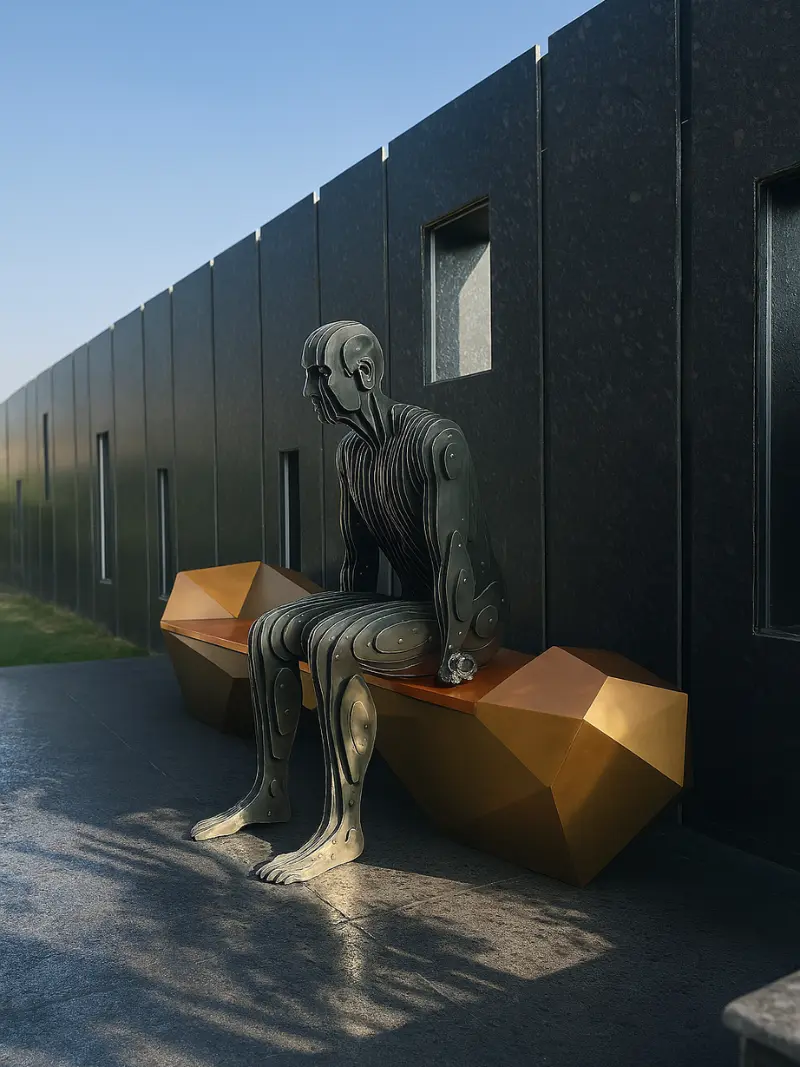
The figure's subtle contouring and joint lines celebrate the precision of digital fabrication while retaining an organic, almost biomorphic presence. This material strategy balances durability requirements with aesthetic goals.
Detailed Budget Breakdown
| Cost Component | Amount (₹) | Percentage |
|---|---|---|
| Design & Engineering | ₹2,16,000 | 18% |
| Materials (316 SS & Steel) | ₹3,24,000 | 27% |
| Fabrication & Finishing | ₹4,08,000 | 34% |
| Transportation | ₹60,000 | 5% |
| Installation | ₹1,20,000 | 10% |
| Permits & Insurance | ₹72,000 | 6% |
| Total Project Cost | ₹12,00,000 | 100% |
Fabrication & Installation Process
Beginning with parametric 3D modeling, each layer was precisely nested in CAD for optimal material yield. CNC laser cutting defined every contour; TIG welding and meticulous grinding unified the form. This digital-to-physical workflow ensured accuracy while minimizing material waste.
On-site, the bench sections were secured to concealed anchor plates, then the figure was bolted in place, ensuring seamless alignment and structural stability. From delivery to commissioning, the full installation took just three days, minimizing disruption to hotel operations.
Lessons Learned & Best Practices
Key success factors included early coordination with hotel operations, detailed pre-fabrication of all components, and careful planning of installation logistics. The modular design approach enabled efficient factory fabrication while simplifying field assembly.
Material selection proved critical—316-grade stainless steel ensures longevity in the urban environment, while powder-coated steel provides color durability. The investment in premium materials reduces long-term maintenance costs.
Impact & Hospitality Integration
Beyond mere seating, this piece acts as a signature landmark—photographed by guests, featured in social media stories, and cited in hotel marketing collateral. It reinforces Crowne Plaza Lucknow's commitment to elevating guest experience through site-specific art, creating a memorable first impression and enhancing brand storytelling.
The installation has generated significant social media engagement, with guest photographs frequently tagged and shared, providing ongoing promotional value that far exceeds the initial investment.
Conclusion & Next Steps
Key Takeaways
Successful public art projects require comprehensive budgeting that accounts for all phases from design through long-term maintenance. Material costs, while significant, represent only one component of total project expenses. Design, fabrication, installation, and ongoing maintenance costs must all be considered for accurate budgeting.
Early investment in professional design and engineering prevents costly modifications and ensures project success. Quality materials and craftsmanship provide better long-term value despite higher initial costs.
How to Get Started with FormForge
FormForge specializes in creating large-scale stainless steel installations that balance artistic vision with practical requirements. Our comprehensive approach includes conceptual design, engineering analysis, fabrication, and installation services.
We provide detailed cost estimates early in the design process, helping clients make informed decisions about scope and materials. Our experience with diverse projects enables accurate budgeting and timeline projections.
Explore More From FormForge
View Our Portfolio
Explore our complete collection of metal sculptures and installations created for temples, homes, and commercial spaces worldwide.
Custom Sculptures
Get a custom god idol designed specifically for your space. Our team will help bring your vision to life with premium materials.
Related Articles

Luxury God Idols & Deity Statues | Stainless Steel, Brass & Corten Steel Collection
Explore Luxury God Idols & Hindu Deity Statues in Stainless Steel, Brass & Corten Steel. Discover custom-crafted Ganesha, Krishna, and Buddha sculptures available in antique, mirror-polished, and natural rust finishes. Designed to be weather-resistant and enduring, our religious idols are ideal for home temples, gardens, and monumental installations.
Outdoor Sculptures in Metal: The Complete Guide to Architectural & Site-Specific Installations
Explore the definitive guide to high-end outdoor sculptures in metal. Learn how corten steel, stainless steel, and bronze installations are designed, commissioned, and built for luxury residences, commercial developments, and public spaces — with Formforge's site-specific approach.